Showing posts with label Nation. Show all posts

Tuesday, September 4, 2012

Artifak Warisan Negara | Artifacts of National Heritage (11th Apr 2011)

On 14th February 2009, 10 artifacts owned by Jabatan Muzium Malaysia were listed in the National Heritage Register. These artifacts have been categorized as Obvious Objects are amongst 173 heritage objects proclaimed as National Heritage. The National Heritage Register is a Register that contains the list of the details of national heritage under Section 23 National Heritage Act 2005.

Warisan Artifak Melayu - Malay Artifacts

Pending Melayu / Malay Belt Buckle
The pending is an ornamental belt buckle which was worn by Malays as part of their ceremonial costume to secure the sarong or sarong as early as the 15th century. The Malay Buckle featured is embossed with a plaited wire design with granules and lotus flower motif. The entire buckle is studded with a variety of coloured gems.

Duit Kijang Emas / Gold Coin (Deer)

The coin is the obverse of the gold coin (deer) believed to have been used during the 16th century depicts a deer. On the right is the reverse of the gold coin which inscripted in Jawi “Malik Al Adil”.

Tepak Sireh / Sireh Set of Sultan Abdul Samad, Selangor

The sireh set featured belongs to Almarhum Sultan Abdul Samad, Selangor (1859-1880) made of silver and plated with gold. The casing is embossed with the design of “ketumbit” flowers, butterflies and the state seal. The receptacles placed inside and the shears are also plated with gold.

Duit Emas / Gold Coin Sultan Muzaffar Shah, Johor

The coin featured is minted form gold and was used during the reign of Sultan Muzaffar Shah, Johor (1564-1570). On the left is the obverse side of the coin with the name of Sultan Muzaffar Shah inscripted in Jawi. The reverse of the coin is depicted on the right with the title of the Sultan as “Khalifatul Mukminin” also inscripted in Jawi.

Arch Buddha Duduk / Arch of Sitting Buddha

This statue of sitting Buddha made of terracotta was found at Pengkalan Bujang, Bujang Valley in the South of  Kedah. It is estimated to be dated between C1000-1100 CE.

Celepa Diraja Terengganu / Royal Terengganu Tobacco Box

The custom of chewing tobacco was introduced in this country centuries ago. Tobacco boxes were an important part of the Malay regalia particularly among the royalty and noble men who wore tobacco boxes suspended from a chain around the waist.

The gold tobacco box featured belongs to the Terengganu royal family approximately during the 18th century is an excellent workmanship by Malay craftsman. It is made in the shape of a ten-pointed star with multi-petal motif designs. In the middle bears a flower design with inlaid with a red ruby with red glass stones surrounding it.

Duit Emas / Gold Coin Sultan Alau’udin Riayat Shah, Johor

The coin features is minted from gold and was used during the reign of Sultan Alau’udin Riayat Shah, Johor (1527/28 – 1564). On the left is the obverse side of the coin with the name of Sultan Alau’udin Riayat Shah inscripted in Jawi. The reverse of the coin is depicted on the right with the title of the Sultan as “Khalifatul Mukminin” aslo inscripted in Jawi.

Loceng Dong S’on / Dong S’on Bell

This bronze Dong S’on bell was found in a village named Kampung Percu, Muar. The designs and patterns of the bronze bell indicates that it originates from Don S’on, North Vietnam. It is dates sometime during the 15th century that is during the Funan Empire.

Duit Emas / Gold Coin Sultan Zainal Abidin II, Terengganu

The coin featured is minted from gold and is used during the reign of Sultan Zainal Abidin Shah II. On the left is the obverse side of the coin with the name  Sultan Zainal Abidin Shah II (1793-1808) inscripted in Jawi. The reverse of the coin is depicted on the right with the title of the Sultan as “Khalifatul Mukminin” in Jawi.

Patung Avalokitesvara / Statue of Avalokitesvara

This status of Avalokitesvara was found in a tin mine that belonging to Anglo Oriental, at Bidor in erak in 1936. It is made of bronze and has eight arms of which however, one hand is broken. It is dated sometime between the 7th and the 12th centuries AD, when the culture of the region was Hindu-Buddhist. The statue weighs 63kg and stands as 93cm height.


Wednesday, October 19, 2011

Istana-Istana DiRaja : Royal Palaces (18th July 2011)

Royal Palaces of Malaysia
Book of Stamps features a compilation of the Royal Palaces in Malaysia. As there are many royal palaces in Malaysia, this stamp issuance features the official palace of the Sultan of each state in Malaysia. Each palace featured in a stamp valued at RM1 has different and unique architecture features and design.

Istana Negara, Kuala Lumpur
Istana Negara is the official residence of His Majesty, the Yang di-Pertuan Agong of Malaysia and Her Majesty Seri Paduka Baginda Raja Permaisuri Agong. It was built on a 28 acre site and located at Jalan Istana opposite the Jalan Syed Putra, Kuala Lumpur. Besides held for the Installation Ceremony of His Majesty Seri Paduka Baginda Yang di-Pertuan Agong, it also serves as a Royal banquet hall, installation ceremony, investiture ceremonies and the taking of oaths by the government ministers and state governors.

Istana Besar Seri Menanti, Negeri Sembilan Darul Khusus
The Seri Menanti Palace situated in Negeri Sembilan is the official residence of the DYMM Yang di-Pertuan Besar of Negeri Sembilan. This new palace was completely constructed in 1931 to replace the previous Seri Menanti Palace.

Istana Shah Alam, Selangor Darul Ehsan
The Shah Alam Palace is situated in Klang, Selangor. Its construction was completed in 1960 on the site of the Mahkota Palace which was demolished in 1958. All official functions and ceremonial of Selangor royalty such as the proclamation, installation and coronation are held in this palace.

Istana Arau, Perlis Indera Kayangan
Istana Arau was beautifully nestled as an emblem for Perlis monarchy, the only state in Malaysia that used ‘Raja’ for the state ruler. This palace is located in Arau, the Royal Town in Perlis. It was built around year 1905 to 1945 during the reign of Almarhum Tuanku Raja Syed Alwi Jamalullail, the former King of Perlis the Fourth who reside before in ‘Rumah Kuning’ near the palace. This palace is a venue for official functions such as investiture ceremonies, served as a state banquet and also for acceptance of the chief departments, Members of Parliament, foreign ambassadors and honored guests.

Istana Maziah, Terengganu Darul Iman
Istana Maziah is the official palace of the Sultan of Terengganu. It is located at the foot of Bukit Puteri in Kuala Terengganu. It was constructed during the reign of Sultan Zainal Abidin III and was built to replace Istana Hijau which was destroyed in a fire. The Palace is the official venue for important functions such as coronation ceremony and royal birthdays, weddings, conferment of titles and receptions for local and foreign dignitaries.

Istana Anak Bukit, Kedah Darul Aman
Istana Anak Bukit is the largest palace in the northern peninsular Malaysia. It is located in Anak Bukit, the royal town of Kedah Darul Aman. It is the royal palace and an official residence to the Sultan of Kedah Darul Aman, Kebawah D.Y.M.M. Tuanku Sultan Haji Abdul Halim Mu’adzam Shah. In conjunction with the Golden Jubilee Celebrations for the 50th years of the reign of the Sultan Kedah Darul Aman, a construction of new building was completed in October 2007 which could accommodate 1,400 people at any one time.

Istana Balai Besar, Kelantan Darul Naim
Built by Sultan Muhammad II in 1840, Istana Balai Besar was originally built to replace his palace at Saba Island which was destroyed by erosion and flood. However, it is now used as an official office for The Sultan of Kelantan as well as a venue for official state functions. Istana Balai besar is the oldest palace in Kelantan and also one of the oldest Malay palaces in Malaysia.

Istana Abu Bakar, Pahang Darul Makmur
Istana Abu Bakar, an official palace for Sultan Pahang is situated in Royal Town of Pekan, Pahang and nearby the sites of Istana Seri Terentang. The construction starts in 1965 and completed its construction in 1974. Design of the palace was done by a Chinese architect and it’s more to modern design. This palace is now the residence of Sultan Haji Ahmad Shah.

Istana Besar, Johor Darul Takzim
Istana Besar constructed in 1866 became the seat of government with the establishment of a state council and offices. It is the birthplace of UMNO in 1946. It houses the Royal Abu Bakar Museum showcasing a wide collection of royal heirloom and artifacts of the Johor Empire from the 16th century.

Istana Iskandariah, Perak Darul Ridzuan
The Iskandariah Palace is situated at Bukit Chandan, Perak on the former site of National Palace. This palace is the official residence of the Rulers of Perak since its completion in 1933. The architecture of this palace is similar to the Islamic Indian ‘saracenic’ blended together with the West Asian architecture such as the pointed arch, design on the minaret and onion shaped domes.

Tuesday, October 11, 2011

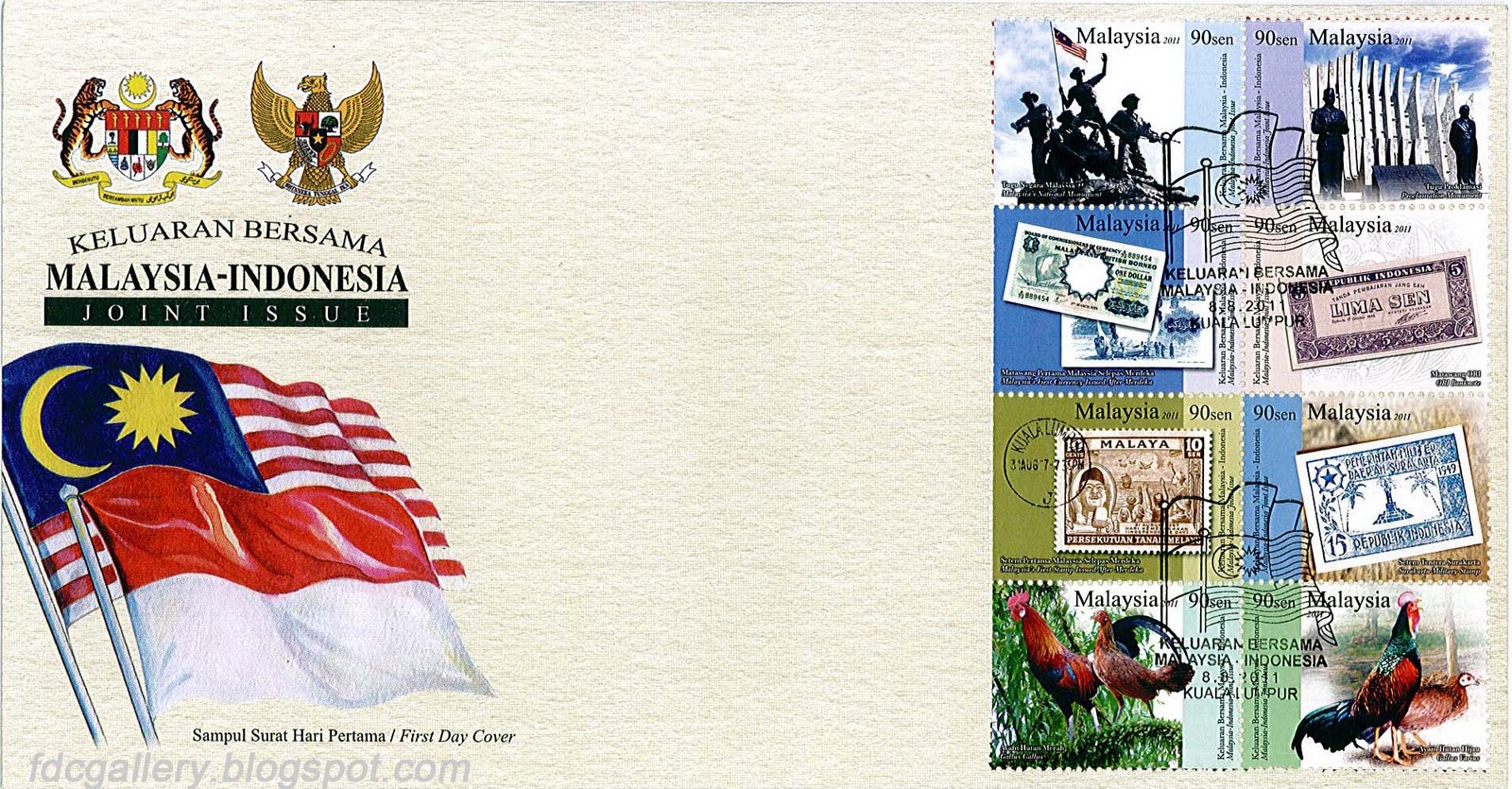
Keluaran Bersama MALAYSIA-INDONESIA Joint Issue (8th Aug 2011)

Malaysia-Indonesia Joint Issue
The stamp issue is produced to promote greater understanding and goodwill amongst the people of the two nations who have much in common and to look back on our respective histories with the aspiration towards achieving our shared destiny of peace, progress and prosperity.

National Monument of Malaysia & Indonesia
Unveiled in 1966, the Tugu Negara is a memorial to those who have given their lives for the freedom of Malaysia. And in Central Jakarta, Indonesia stands the Proclamation Monument which features images of the first President Soekarno and the vice-president Mohamad Hatta at the reading of the Proclamation of Independence of Indonesia.

Currency of Malaysia & Indonesia
Malaya issued her first currency note in 1959. Reflecting the agrarian economy at the time, the first one dollar note featured a sailboat being hauled ashore by a crew of fishermen. Indonesia’s first currency note, Oeang Republik Indonesia was introduced on 3rd October 1946 during a difficult time. Later when the Japanese and Dutch currencies were phased out, a more stable system was introduced.

First Stamp Issued After Merdeka
Malaya’s first stamp was a 10-cent denomination featuring Malaya’s first Prime Minister Tunku Abdul Rahman in the foreground and an endearing crowd of Malayans in the background. Indonesia’s first stamps with native scenes incorporated into the design such as rice cultivation with the aid of a buffalo and images of native dancers were introduced in the 1930s.

The Red & Green Jungle Fowl
Two unique jungle fowls complete the setenant strip in this joint issue. The Red Jungle Fowl (Gallus gallus) is the ancestor of the domesticated chicken while the green jungle fowl (Gallus varius), a unique bird also known as bekisar, and endemic only to Java and a few of the islands such as Flores, Lombok and Komodo, represents the wildlife of Indonesia.